Wednesday, September 25, 2013
Hello my colleagues
I have written a draft of my session plan and I hope you will read it and give me important and useful feedback
Objective: Particioants wii raise awareness how to use scaffolding instructions in the lesson plans.
Stages:
I. "Get to know" activity. 1. introduce myself with my profile. (write my name on the paper and draw some pictures or figures about my life and expectations and participants should guess what they mean. 2. they should the same, go round the room and try to guess each other's profile.
II. divide them in three groups. (according to their months of birth|)
III. Reflection : what they know or remember about scaffolding
I will read a story (this story is written on the power point ) "how a toddler learn to walk" and they should guess which teaching strategy it comes with.
IV. Brainstorming: Participants should ask some questions: 1. What theory is the foundation of scaffolding; 2.who is the founder and what they know about him; 3.what is the main concept of this theory. (after each answer I will show them my presenation about these questions). Then I will show a five minute-video ( I have downloaded it)
V. After watching this video, they should answer and discuss some questions: 1. what they saw; 2.what they know and not know about scaffolding. 3. why is scaffolding important for the teaching process.
VI. Introduce the topic: one example from real life how to use scaffolding instructions. I "teach" them "How to saw on a button" . Then, questions: 1.what and how they have done. 2.why I have done this activity
VII. I will make a power point presentaion about scaffolding instructions.
VIII. Participants should think how they teach young learners e.g. A-a; B-b (each group presents their ideas)
IX. I will distribute one lesson from the students' textbook and write the general objective on the board and the participans shoul write a lesson plan. Then volunteers from each group present their lesson plans
X. Reflaction: questions: 1. what stages were of this session; (I will write their answers and then they should classify in the chart: Instructor does it:
class does it:
group does it:
individual does it:
2. what they learnt
3. why the scaffolding and its instructions important for the learning and teaching process.
(Participant think the answers and discuss them and then say ones. )
I am looking forward to your feedback, they are imporatan for me as usual.
with love
Tea
Thanks

Monday, September 23, 2013
Lesson plan 23.09.2013 class III
Objective: I. By the end of the lesson students will be able to classify the words into two parts: 1. Parts of the body;
2. Parts of the house (garden;bathroom; door; stairs; kitchen; window; foot; hand; hair; arm; leg; nose.)
II. By the end of the lesson students will be able to write new words-parts of the body (foot; feet; hand; hair; arm; leg; nose.)
At the begining: Checking homework (workbook-pg 52; ex.1;2) (10mn) Students read them.
Activity 1. Teacher shows the flashcards: the parts of the house (garden; door; stairs; kitchen; window; )
Studsents guess the pictures and say the words in English.(Teacher helps to guess with simple sentences: we wash our hands in the....we cook our food....teacher uses miming ) (5mn)
activity 2. Students do the ex. 1 pg.53(workbook) (5mn)
Activity 3. Stydents are divided into four groups. Teacher distributes some strips of paper with the words:parts of the body and parts of the house and the students should classify them under the main sentence. Then they say these words and teacher writes their answers on the board.(10mn)
Activity 4. Students copy these words in their exercise-books. (to practise the words) (5mn)
Activity 5. Dictation. Teacher dictates the new words and check (8mn)
Homework: Teacher gives the students some instructions. Ss. make up simple sentences using new words. e.g. I have a .....; It is a.....(2mn)
Photos of the lesson
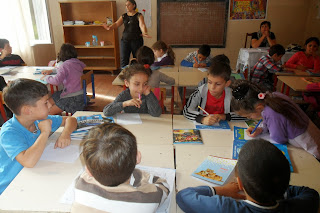
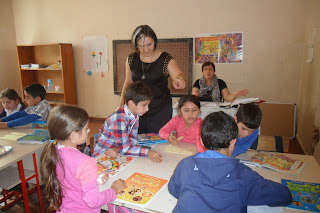
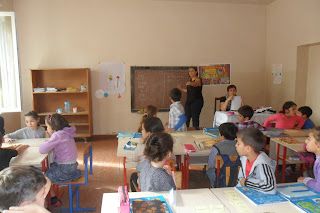
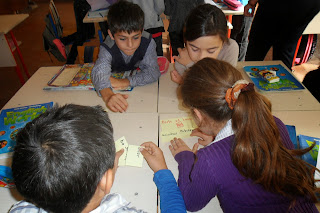


Wednesday, September 18, 2013
Tuesday, August 13, 2013
Micro-training
- This day was quite different from other days. We had to plan and deliver a micro-training sessions ourselves. Before this we were divided in three groups. Ten teachers were in one group. We wrote a a plan of our training and we would demonstrate activities. We had only 20 minutes to deliver the session.
One of us was delivering a training, our trainer Kevin ( he is very helpful and supportive) and one of the group members were observing it and making notes.
At the end of my training, other members and our trainer gave me feedback, which was very useful and interesting process for my self-assessment.
That was very good excperience for all of us.
My plan ( it is wriiten for one hour) :
Objective: Teacher will plan scaffolding lesson with sequences of activities.
Warm up: Trainer does the activity about how to get to know each other. (e.g Teachers stand in a circle and say their first name and adjective with first letter) ( 5 mn)
Activity1: Trainer reads some sentences and Teachers should lesten carefully. ( 1. This person was a phsycologist; 2. He proposes that social interaction plays a foundamental role in the development of cognition; 3. The learner does not learn in isolation; 4. It helps students to develop inner or egocentric speach.) Then she\he asks some questions. Teachers write down them on the board ( 10mn)
Lev Vygotsky
/ /
Sociocultural theory ZPD ( zone of proximal developmwnt)
<scaffolding>
( questions: 1. What is this theory and who is the founder of this theory; 2. What is the concept of the theory; 3. When does the teacher activate this zone; 4. Which teaching strategies originate from this theory.) ;
Activity 2: Trainer distributes some slips of paper with activities from a lesson plan and Teachers put them in order ( to sequence the activities) . Trainer elicits the answers. ( 5 mn )
Activity 3:Trainer gives the topic to the teachers and asks them to write a lesson plan. Teachers work in groups. (20mn)
Activity 4: Teachers stick their lesson plan on the wall and share them and ask some questions to each other. (10mn)
Activity 5: Trainer asks some questions and Teachers write them down. Think about these and share their ideas in pairs. Trainer elicits them. (10mn)
(Questions: 1. What did you learn? 2. Why is this topic important
3. How would you adopt the objective? 4. What were the steps of my workshop. )
Sunday, August 11, 2013
The seventh day in World Learning Campus
We had more free time today. We relaxed and rested after visiting New York City. We were in NYC yesterday. It was exciting and amazing. NYC is very nice city with skyscrapers. We saw The Statue of Liberty, Madam Tussauds, people of diverse culture and nationality Trump Tower and a lot of famous avenues and streets.
Today our trainers began the seminar with reflection "Giving feedback".
Giving feedback is:
Today our trainers began the seminar with reflection "Giving feedback".
Giving feedback is:
- oral and written
- productive
- useful
- important
- helpful
- supportive
- positive
- objective
Giving feedback helps teachers to check and analyze what works well and do not well. It enables teachers to plan other lessons and trainings and it helps them to improve themselves.
What makes good feedback?
- good observation
- make good notes
- constructive
- good suggestions
- good and appropriative language
- positive attitude
Ways of feedback:
- Directive: Give the teacher feedback on your points, particularly on points to work on.
- Alternative: Go through the lesson with the teacher, giving alternative to stage/activity
- Collaborative: I-Ask the teacher to give his/her own feedback; II- Try to make use of what the teacher says in giving your feedback; III- Give the teacher feedbacks, starting with positive points; IV- Finish with points to work on.
To my mind three of them are very important and useful. To use them depends on the situations and persons.
Our Trainers did a role-play activity and we had to give feedback. It was very good activity to learn more how to give feedbacks.
Friday, August 9, 2013
The fifth day in World Learning Campus
The day was fruitful and useful too. All seminars were intereseting.
 Workshop began with reflection. We were divided into five groups. There were six teachers in one group, sitting face to face in a circle. Three teachers were sitting inside the circle and three teachers outside the circle facing each other. Andy asked some questions and we discussed them with each other. After each question teachers outer circle change their seats- clockwise.
Questions and teachers ideas:
Lack of Teaching resources: supplimentary materials; internet. Flash cards; Flip charts;
How can we provide this? To search websites which help them to find out detail and more information.
To draw pictures.
Lack of respect/prestige : less teachers' experience; not friendly atmosphere.
Helping them to improve new teaching strategies ; to make friendly and comfortable atmosphere with various and funny activities. Also should arrange out class activities.

 We were surprised.
 Workshop began with reflection. We were divided into five groups. There were six teachers in one group, sitting face to face in a circle. Three teachers were sitting inside the circle and three teachers outside the circle facing each other. Andy asked some questions and we discussed them with each other. After each question teachers outer circle change their seats- clockwise.
Questions and teachers ideas:
Lack of Teaching resources: supplimentary materials; internet. Flash cards; Flip charts;
How can we provide this? To search websites which help them to find out detail and more information.
To draw pictures.
Lack of respect/prestige : less teachers' experience; not friendly atmosphere.
Helping them to improve new teaching strategies ; to make friendly and comfortable atmosphere with various and funny activities. Also should arrange out class activities.

Process categories in teaching training was new for me.
Leading: On the learner centered side of the model-and still concerned with the development of knowledge or understanding.
Feeding: otherwise known as the "jug and mug model" or less emotively, the transmission model.
showing: designed to provide concrete experiences, to bring things to life.
Throwing: a matter of giving participants the opportunity to do.
We had also some sessions about How to teach Culture and How trainers give clear instructions.
P.S
When we went out from dining room we saw a squirrel.
 We were surprised.
Subscribe to:
Posts (Atom)